

*Stats based on FBI Internet Crime Report 2023 & 2024 Data Breach Investigations Report
Block known bad emails, let known good emails through to end users
Natural language processing (NLP) and ML capabilities analyze email content, identifying subtle anomalies and suspicious activity.
Multiple signals and technologies create a comprehensive view of threats, enabling blocking at the point of detection.
Limit manual intervention with models that continuously learn and improve.
Enable your employees to be more security conscious, and identify and remediate riskier users.
The challenge? Managing and tuning vast amounts of data due to high false positives from AI-only solutions.

Threat actors continuously change their techniques requiring detections that do not rely on signatures or heuristics.

A broader attack surface creates an overwhelming amount of data for security teams to parse.

AI-only solutions often generate false positives, requiring constant tuning and human oversight.
Automatic classification of whether a message is potentially a form of BEC attack or not consequently requires AI models that are able to not only identify words but understand the intent. The models must understand generic, underlying patterns which humans are not able to comprehend.
BEC attacks are often very subtle and sometimes provide very little to no clue within the body of the email. Mimecast will not only analyze the message body for sentiment, but also the subject line to determine if there are any risky indicators which may trigger a policy.
Not only will we include the ability for you to set policies based on the confidence level of a detection, but you will also have policy modelling functionality to determine which messages may be caught.
Highlighting the sender is important but being able to leverage our social graphing technology from Cybergraph to be able to provide contextual information on the sender at an individual and organizational level. This provides admins the ability to understand more about who sent the message to understand why it was rejected or held.
Mimecast doesn’t solely rely upon NLP text extraction and a threat model to detect a BEC attack.
To effectively identify anomalies and suspicious emails, artificial intelligence capabilities are essential for detecting even the subtlest signs of malicious activity. Mimecast’s Advanced BEC protection utilizes AI to analyze communication patterns, writing styles, and contextual clues to block threats beyond malware or phishing links.
By leveraging billions of signals from across our platform, our AI detection continuously adapts to evolving threats using a multi-layered approach that prevents potential financial losses and data breaches.
Mimecast’s connected human risk management platform offers administrators deep visibility into BEC threats, providing actionable insights for informed security policy decisions and targeted mitigation strategies.

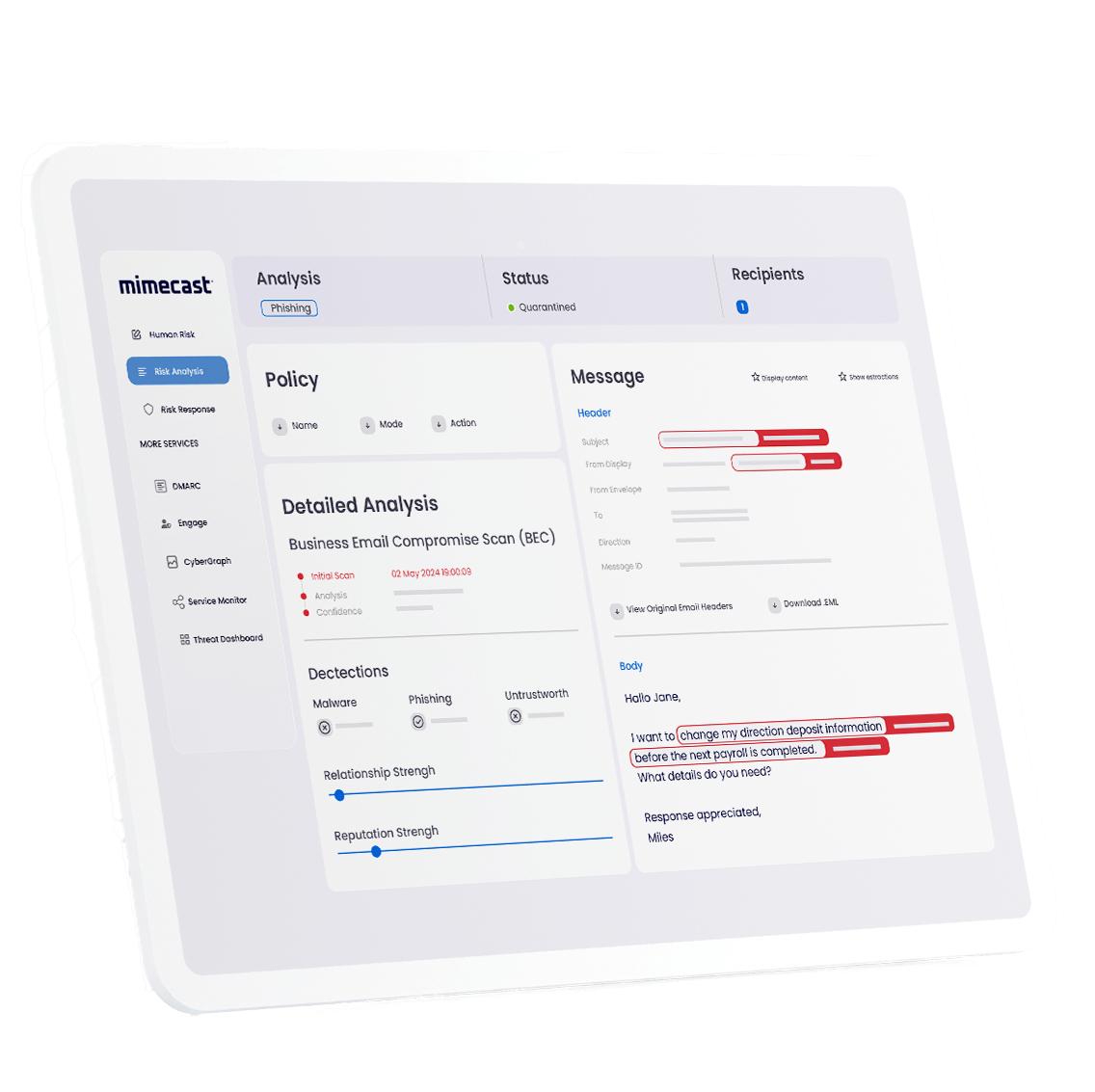
Focus on understanding the context, nuances, and implications of both the message and subject line to accurately interpret the true intention
Identifies subtle deviations in sender behavior, writing style, timing, and communication patterns to detect sophisticated Business Email Compromise attempts before damage occurs.
Advanced detection models specifically designed to prevent CEO fraud, vendor payment redirection, and executive impersonation attacks targeting high-value individuals.
Every email is dynamically assessed and assigned a risk score based on intent, linguistic signals, sender authenticity, and contextual relationships—stopping threats before users engage.
Chillisoft will help you understand how Mimecast can help with your security needs.
